


In today’s competitive Canadian market, your technology should be an asset that drives growth, not a source of unpredictable costs and frustrating distractions. Yet for many business owners, IT means dealing with sudden system failures, worrying about cybersecurity threats, and struggling with the high cost of hiring in-house experts. If this sounds familiar, it’s time to move beyond the reactive ‘break-fix’ cycle. This is where understanding managed services becomes a game-changer for your business.
This proactive approach to IT support is designed to prevent problems before they disrupt your operations. But what does it actually involve, and how is it different from traditional IT help? We created this guide to give you clear, practical answers.
You’ll learn how a managed services partnership can help you secure your data, gain predictable monthly costs, and access enterprise-level expertise without the high overhead. Let us show you how to optimize your technology, so you can focus on what matters most: growing your business.
Key Takeaways
- Understand the critical shift from reactive “break-fix” IT to a proactive strategy that prevents problems before they impact your operations.
- Discover why traditional IT support models often result in unpredictable costs and higher risks for Canadian small and medium-sized businesses.
- Learn how adopting managed services can directly improve your bottom line by increasing efficiency, strengthening security, and controlling IT spending.
- Find out what to expect from a Managed Service Provider (MSP) and how to identify a true strategic partner for your business growth.
Beyond the Definition: The Core Components of Managed Services
While often simplified as just ‘outsourcing IT,’ the reality of modern managed services is far more comprehensive. It’s not about waiting for something to break; it’s a proactive partnership designed to optimize, secure, and stabilize your entire technology ecosystem. A true managed service provider (MSP) delivers a suite of integrated solutions that work together, creating a robust and strategic foundation for your business. Let’s break down the core components that make up this essential service.
Managed IT Infrastructure
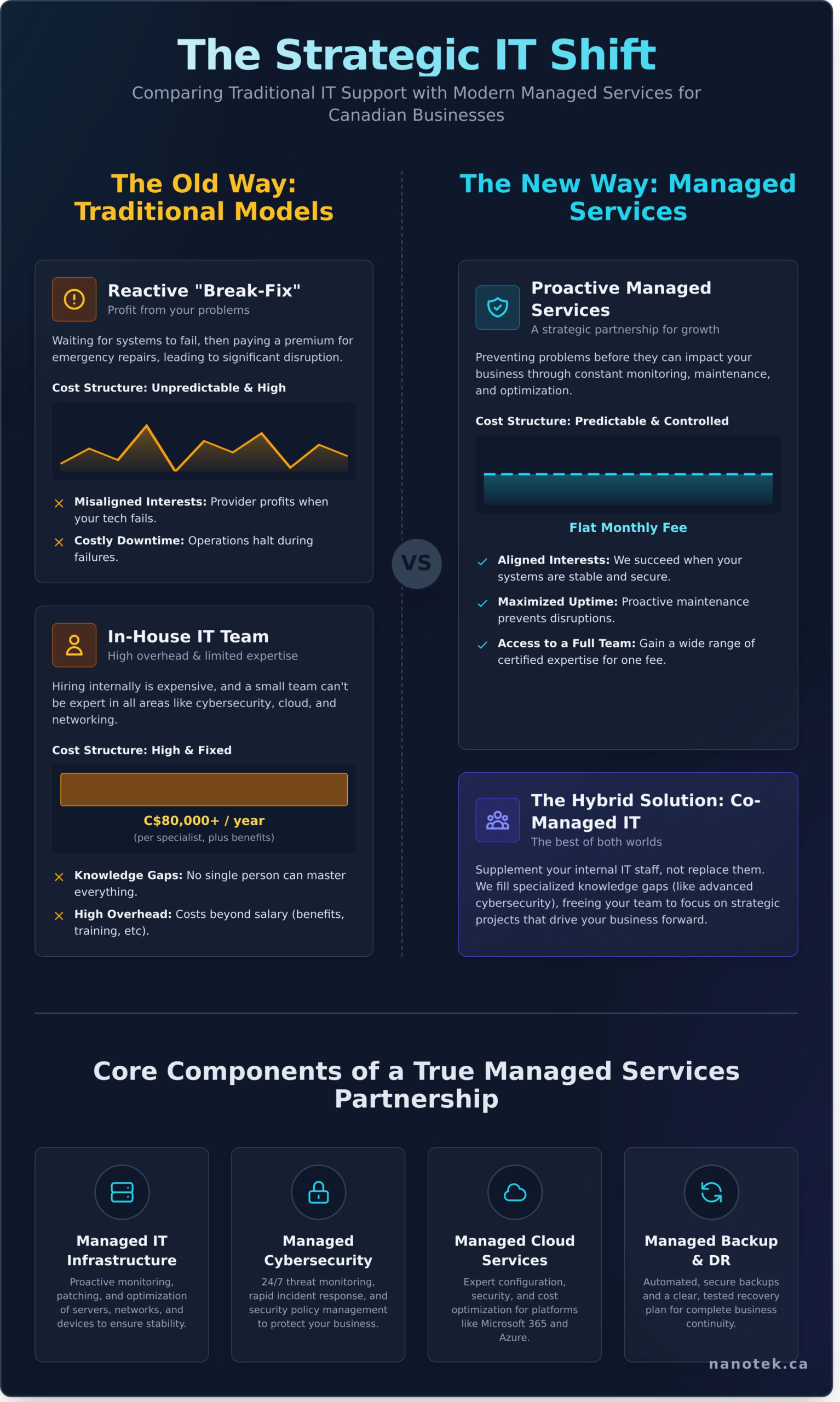
This is the bedrock of your daily operations. It covers the complete lifecycle of your physical and virtual hardware-from servers and networks to desktops and mobile devices. Rather than reacting to failures, we proactively monitor system health, manage critical patching and updates, and continually optimize performance. This ensures the technological backbone of your business is always stable, reliable, and ready to support your team.
Managed Cybersecurity
In today’s threat landscape, a basic antivirus is not enough. Managed cybersecurity is an active, 24/7 defence system. It involves constant threat monitoring and rapid incident response to neutralize attacks before they cause damage. This service also strengthens your human firewall through security policy management and employee training, protecting your Canadian business from sophisticated threats like ransomware, phishing, and costly data breaches.
Managed Cloud Services
Leveraging platforms like Microsoft 365 and Azure can transform your business, but managing them effectively requires expertise. This component focuses on the expert configuration, security, and optimization of your cloud environment. We handle everything from seamless cloud migrations to managing your subscriptions, ensuring you avoid unnecessary costs and that your cloud infrastructure is both powerful and secure.
Managed Backup and Disaster Recovery
What would happen if your critical data disappeared tomorrow? This service provides the answer and the peace of mind that comes with it. We implement automated, secure backups of your essential business data and establish a clear, actionable plan to restore operations after any incident. Regular testing ensures data integrity, providing the business continuity you need to operate with confidence, no matter what happens.
The Strategic Shift: Managed Services vs. Traditional IT Models
In today’s competitive landscape, the way a business manages its technology can be the difference between stagnation and growth. Many small and medium-sized businesses in Canada still rely on outdated IT support models, often without realizing the hidden costs and risks. Understanding the difference between these traditional approaches and modern managed services is the first step toward optimizing your IT infrastructure for success. Let’s compare the most common models to help you identify where your business stands.
Proactive vs. Reactive: The Break-Fix Model
Does your business only call for IT support when a server crashes or a laptop fails? This is the “break-fix” model-a purely reactive approach. The fundamental issue is a conflict of interest: the provider profits when your technology fails. This leads to unpredictable, often high, emergency repair bills and, more importantly, costly downtime that disrupts your operations. In contrast, a managed services provider operates on a proactive model, focused on preventing problems before they can impact your business.
Outsourcing vs. In-House IT Team
An in-house IT team offers direct control, but at a significant cost. Hiring just one full-time IT specialist in Canada can easily cost over C$80,000 annually with salary, benefits, and training. Furthermore, a small team often has knowledge gaps; one person cannot be an expert in cybersecurity, cloud architecture, and daily helpdesk support. Managed services provide access to an entire team of certified experts for a single, predictable monthly fee, eliminating the overhead of recruitment, vacation time, and sick leave.
The Best of Both Worlds: Co-Managed IT
For businesses with an existing IT staff, a hybrid model known as co-managed IT offers a powerful solution. Here, an MSP supplements your internal team, not replaces it. This partnership allows your business to realize many of the benefits of the managed services model, such as enhanced security and scalability, while retaining direct internal oversight. We can fill specialized knowledge gaps-like advanced cybersecurity or cloud management-freeing your staff to focus on strategic projects that drive your business forward.
What to Expect from a Managed Service Provider (MSP)
Choosing an MSP is more than just outsourcing your IT; it’s about forging a long-term strategic partnership. A professional provider works to demystify technology, establishing a relationship built on trust, transparency, and clear communication. They provide the framework for success through formal agreements, measurable performance, and a structured onboarding process, ensuring you always know the value you are receiving.
The Service Level Agreement (SLA) Explained
The SLA is the cornerstone of your relationship with an MSP. This formal contract moves beyond promises and defines the exact standards of service you will receive. It is your guarantee of accountability. Before signing any contract, it is critical to review this document to ensure it aligns with your business requirements. Key elements typically include:
- Response and Resolution Times: Guaranteed timelines for acknowledging an issue and for resolving it based on its severity.
- Uptime Guarantees: A commitment to system availability, often expressed as a percentage like 99.9%.
- Scope of Support: A clear definition of which systems, users, and services are covered under the agreement.
Key Performance Indicators (KPIs) and Reporting
A reputable MSP doesn’t just work in the background; they demonstrate their value with clear, data-driven insights. You should expect regular reports (typically monthly or quarterly) that are easy to understand and translate technical metrics into business impact. These reports track KPIs such as system uptime, ticket resolution speed, and security threats neutralized. These review meetings are the perfect opportunity for strategic planning, helping you align your technology budget with future business goals.
The Onboarding Process: What’s Involved?
The initial onboarding phase is critical for a successful partnership. This is where your new MSP transitions from a provider to a true partner. The process involves a deep discovery of your current IT environment to understand every component. From there, they will deploy essential monitoring and security tools, document your systems and processes, and establish secure access. A smooth, thorough onboarding ensures your provider can proactively manage your infrastructure from day one.
Ultimately, a quality provider of managed services delivers peace of mind through a structured, accountable partnership. They handle the complexities of your cloud environment, so you can focus on driving your business forward. To learn how a strategic partnership can benefit your Canadian business, explore our tailored IT solutions.
The Business Impact: Key Benefits of Adopting Managed Services
Understanding the technical features of cloud solutions is one thing; translating them into tangible business growth is another. For Canadian small and medium-sized businesses (SMBs), adopting managed services is a strategic decision that directly impacts the bottom line. It’s about shifting IT from a source of unexpected costs and frustrations to a powerful driver of efficiency, security, and innovation. Let us handle the technology, so you can focus on what you do best: running your business.
Predictable Costs and Reduced Capital Expenditure
Move away from the costly break-fix IT model. Instead of facing large, unpredictable bills for IT emergencies or hardware upgrades, you transition to a fixed monthly operational expense (OPEX). This model eliminates the need for significant upfront capital expenditure (CAPEX) on new servers or software licenses, freeing up cash flow and making your IT budget stable and predictable. Get a predictable IT budget with our managed services.
Access to Enterprise-Level Expertise
Hiring a full-time, in-house specialist for every IT discipline is not feasible for most SMBs. A managed services provider gives you immediate access to a deep bench of certified experts in critical areas, including:
- Cybersecurity strategy and threat response
- Cloud architecture and migration
- Network infrastructure and management
- Data backup and disaster recovery
This ensures your technology strategy is always guided by current best practices, giving you a competitive edge.
Enhanced Security and Compliance
In today’s digital landscape, your data is your most valuable asset. We implement proactive, multi-layered security measures to protect your business from evolving cyber threats. An expert MSP also helps you navigate and meet complex Canadian compliance requirements like PIPEDA, reducing the risk of costly data breaches, fines, and reputational damage. We make your security and compliance a priority, so you don’t have to.
Increased Uptime and Employee Productivity
Downtime is more than an inconvenience; it’s a direct hit to your revenue. Through proactive 24/7 monitoring and strategic maintenance, we prevent problems before they can disrupt your operations, maximizing system uptime. When your team does need help, they get fast, effective support. When technology works seamlessly, your employees can stay focused and productive, driving your business forward without IT-related delays.
Elevate Your Business with a Strategic IT Partner
The takeaway is clear: modern businesses thrive not by simply fixing IT problems, but by proactively preventing them. Shifting from a traditional break-fix model to a partnership with an expert provider transforms your technology from an unpredictable expense into a strategic asset. Adopting managed services means gaining predictable costs, enhanced security, and the invaluable freedom to concentrate on your core business goals, not your IT infrastructure.
Since 1998, Nanotek has been driving businesses forward across Toronto, Mississauga, Brampton, and the GTA. With a proven track record of over 110,000 resolved support tickets, we are dedicated to providing the expert, tailored solutions your company deserves. Let us handle the complexities of your technology so you can focus on innovation and growth.
Frequently Asked Questions About Managed Services
What is the difference between managed services and IT support?
Traditional IT support is reactive; it focuses on fixing problems after they occur. In contrast, managed services are proactive. A Managed Service Provider (MSP) continuously monitors, manages, and optimizes your IT infrastructure to prevent issues before they disrupt your business. This strategic approach ensures system security, efficiency, and uptime, aligning technology with your core business goals rather than just responding to break-fix incidents.
Are managed services only for large companies?
Not at all. Managed services are an ideal and cost-effective solution for Canadian small and medium-sized businesses (SMBs). For many SMBs, building an in-house IT department is not financially feasible. An MSP provides access to a full team of certified experts and enterprise-grade technology for a predictable monthly fee, allowing smaller companies to compete effectively and focus their resources on growth and innovation.
How much do managed services typically cost?
In Canada, the cost for managed services often ranges from C$75 to C$250 per user per month. The final price depends on the scope of services required, such as 24/7 helpdesk support, advanced cybersecurity, cloud management, and vendor coordination. This predictable pricing model eliminates surprise IT expenses and allows for more accurate and strategic budgeting, turning your IT from a capital expense into a stable operational cost.
What industries benefit most from managed services?
Industries with strict regulatory and data security requirements, such as healthcare (PIPEDA compliance), legal, and financial services, see immediate benefits. However, manufacturing, professional services, and non-profits also gain a significant competitive edge through optimized uptime and enhanced operational efficiency. Any Canadian business that depends on technology to succeed can leverage managed services to improve security, reduce downtime, and accelerate growth.
How do I choose the right Managed Service Provider (MSP) for my business?
Look for an MSP with proven experience in your industry and a deep understanding of the Canadian market. Verify their technical certifications, review client testimonials, and ensure they are experts in Canadian data privacy laws like PIPEDA. The right partner will offer a clear Service Level Agreement (SLA) and act as a strategic advisor, creating a tailored IT roadmap that aligns directly with your business objectives.
Will I lose control over my IT if I hire an MSP?
No, you will gain more strategic control. A partnership with an MSP is about empowerment, not abdication. You set the direction and make the key business decisions, while your MSP handles the complex, day-to-day technical management. This collaborative approach frees your team from firefighting IT issues, allowing you to focus on high-level strategy and using technology to drive your business forward with confidence.