


In today’s competitive Canadian market, technology should be your greatest asset, not your biggest headache. Yet for many business leaders, navigating the complexities of it services-from cybersecurity threats and potential downtime to unpredictable costs-can feel overwhelming. You know technology is critical for growth, but you may be unsure which specific solutions you actually need or how to manage them without straining your budget.
This guide is designed to provide a clear solution. We will demystify the world of business technology, breaking down the essential services that drive security, efficiency, and growth. You will learn how to identify your company’s most critical needs and understand what to look for in a technology partner. Let us help you move from uncertainty to a confident, strategic IT plan, so you can gain the peace of mind to focus on what you do best: driving your business forward.
Key Takeaways
- View technology as a strategic asset, not just a cost. Modern it services are designed to align directly with your business objectives for growth and operational efficiency.
- Discover the four core pillars of IT every business needs, from securing your critical data to empowering your team with the right collaboration tools.
- Understand how cloud services offer Canadian businesses unparalleled flexibility and scalability, reducing the need for expensive on-site hardware.
- Learn how to evaluate and choose the right IT partner by focusing on long-term value and strategic fit, not just the lowest upfront cost.
What Exactly Are IT Services? More Than Just ‘Tech Support’
When business leaders hear the term “IT services,” their minds often jump to the classic image of a technician fixing a broken computer. While that’s a piece of the puzzle, it’s a drastically outdated view. Modern it services encompass the strategic management of your entire technology ecosystem-from servers and software to cybersecurity and cloud infrastructure. The primary goal is no longer just fixing what’s broken; it’s about proactively aligning your technology with core business objectives to drive growth, boost efficiency, and secure your operations.
Businesses today can choose from several delivery models to achieve this alignment, including dedicated in-house teams, a co-managed approach that blends internal staff with external experts, or a fully outsourced partnership. This evolution reflects a broader shift in the industry toward an IT as a Service (ITaaS) model, where technology is delivered as a managed, business-focused solution rather than a collection of internal hardware.
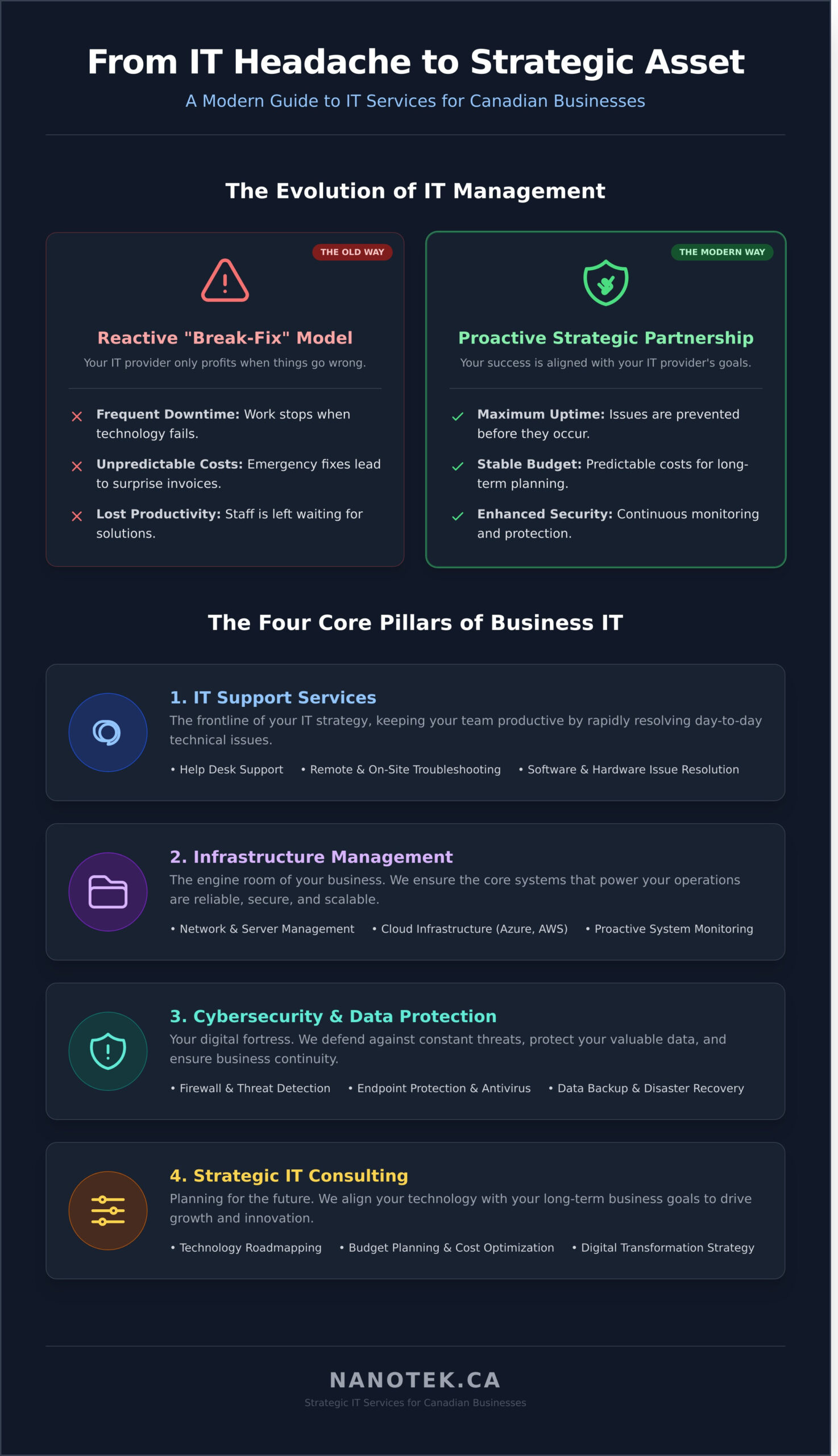
The Shift from Break-Fix to Proactive Partnership
The traditional “break-fix” model is simple: when technology fails, you call for help. This reactive approach creates a cycle of downtime, lost productivity, and unpredictable costs that can cripple a growing Canadian business. In this model, your IT provider only profits when your systems are down. A proactive partnership flips this script entirely. By using continuous monitoring and preventative maintenance, issues are identified and resolved before they can impact your business, ensuring maximum uptime, reliability, and security.
Why Strategic IT is a Competitive Advantage for SMBs
For small and medium-sized businesses across Canada, viewing IT as a strategic asset instead of a cost centre is a powerful competitive advantage. A well-managed technology framework isn’t just about preventing problems; it’s about creating opportunities and building a more resilient, efficient, and trusted organization.
- Enhanced Employee Productivity: When systems are reliable and tools are optimized, your team can focus on their core responsibilities without being hindered by technical glitches or slow performance.
- New Efficiencies and Revenue Streams: Strategic IT can automate manual processes, provide data-driven insights, and enable new services-like cloud-based applications-that open up new avenues for revenue.
- Reputation and Security: In an era of constant cyber threats, robust security isn’t optional. Protecting your data and your clients’ information is crucial for maintaining trust and safeguarding your business’s reputation.
The Core Categories of IT Services Every Business Needs
Navigating the world of technology can feel overwhelming. The term “IT services” itself is a broad umbrella covering countless specializations. While Gartner’s definition of IT services frames them as the application of technical expertise to achieve business outcomes, it’s more practical for business owners to think of them in terms of core functions. We group these essential services into four strategic pillars to help you identify exactly what your business needs to thrive.
1. IT Support Services: Keeping Your Team Productive
This is the frontline of your IT strategy, focused on providing day-to-day assistance to your employees. When a team member can’t access a file or a critical application crashes, productivity grinds to a halt. The primary goal is to resolve these issues quickly and efficiently, minimizing downtime and frustration so your staff can focus on their work.
- Help desk support
- Remote and on-site troubleshooting
- Software and hardware issue resolution
2. Infrastructure Management: The Engine Room of Your Business
Behind every productive employee is a stable and secure technology foundation. Infrastructure management focuses on the core systems that power your operations, from the network connecting your office to the cloud platforms you rely on. We ensure this engine room is reliable, secure, and scalable enough to support your business as it grows.
- Network and server management
- Cloud infrastructure support (e.g., Microsoft Azure)
- Proactive system monitoring and maintenance
3. Cybersecurity & Data Protection: Your Digital Fortress
In Canada’s digital economy, your data is one of your most valuable assets. Protecting it isn’t optional-it’s essential for survival. This category of services builds a digital fortress around your business, defending against constant threats and ensuring you can recover from any incident. Our focus is to safeguard your operations and ensure complete business continuity.
- Firewall management and threat detection
- Endpoint protection and antivirus solutions
- Robust data backup (like our NanoBackup solution) and disaster recovery planning
4. Strategic IT Consulting: Planning for the Future
The best technology solutions don’t just solve today’s problems; they pave the way for tomorrow’s growth. Strategic consulting provides the high-level guidance needed to align your IT investments with your long-term business objectives. This ensures every dollar spent on technology delivers a tangible, measurable return and accelerates your success.
- Technology roadmaps and budget planning
- Vendor management and procurement
- Virtual CIO (vCIO) services for executive-level strategy
Understanding Cloud Services: The Future of Business IT
In simple terms, cloud services allow your business to access technology resources like software, servers, and storage over the internet instead of hosting them on-premises. This model fundamentally changes how companies approach their technology needs, shifting from large capital investments to flexible operational expenses. The modern landscape of what the Gartner definition of IT services describes is increasingly dominated by the cloud, which empowers Canadian small and medium-sized businesses (SMBs) with unparalleled flexibility, scalability, and cost-effectiveness. At Nanotek, we harness these platforms to deliver secure and efficient solutions tailored to your goals.
Software as a Service (SaaS): Your Applications, Anywhere
SaaS is the most common cloud service model, where you subscribe to software applications instead of purchasing them outright. A prime example is Microsoft 365, which gives your team access to essential tools like Outlook, Word, and Teams from any device. The benefits are immediate:
- Predictable Costs: A simple, per-user monthly fee in C$ makes budgeting easy.
- Automatic Updates: You always have the latest features and security patches without any IT intervention.
- Enhanced Collaboration: Teams can work on documents simultaneously, boosting productivity.
Other common SaaS solutions include CRM platforms and cloud-based accounting software.
Infrastructure as a Service (IaaS): Your Data Centre in the Cloud
Think of IaaS as renting the fundamental building blocks of a data centre-servers, storage, and networking-from a cloud provider like Microsoft Azure. This model, which powers our NanoCloud solutions, eliminates the need for you to purchase and manage expensive physical hardware. IaaS allows your business to scale resources up or down on demand, ensuring you only pay for the computing power you actually use. It’s the ultimate foundation for flexible and powerful it services.
Communications and Backup (UCaaS & BaaS): Connecting and Protecting
Specialized cloud services are designed to solve specific business challenges. Our NanoVoice (Unified Communications as a Service) offering replaces traditional phone systems with a modern, feature-rich VoIP solution that works anywhere. Meanwhile, NanoBackup (Backup as a Service) provides automated, secure, and off-site data protection. Together, these services are critical for supporting remote work and ensuring your business remains resilient in the face of disruption.
How to Choose the Right IT Service Provider for Your Business
Selecting a partner for your technology needs is one of the most critical business decisions you will make. The goal isn’t to find the cheapest option, but to secure a strategic partner who delivers the best value and aligns with your business goals. The right provider acts as an extension of your team, providing the expert it services that drive efficiency and empower growth.
Step 1: Assess Your Current and Future Needs
Before evaluating providers, you must first understand your own requirements. A clear picture of your operational needs ensures you find a partner who can scale with you. Consider your current number of employees and physical locations, any industry-specific compliance standards you must meet (like PHIPA in Ontario), and your strategic business goals for the next one to three years. This internal audit will define the scope of services you require.
Step 2: Key Questions to Ask Potential Providers
Once your requirements are mapped out, it’s time to interview potential partners. Asking detailed questions will reveal their true capabilities and service philosophy. Key questions include:
- What are your average response and resolution times? This demonstrates their commitment to minimizing your downtime and keeping your team productive.
- Do you have experience with businesses in our industry? A provider with industry-specific expertise understands your unique challenges and compliance needs.
- Can you provide client testimonials or case studies? Proven success stories and satisfied clients are the best indicators of reliable, high-quality service.
- How do you proactively manage cybersecurity? In today’s threat landscape, a proactive, multi-layered security strategy is non-negotiable.
Step 3: Look for Local Expertise and a True Partnership
While many cloud services can be managed remotely, the value of a local partner cannot be overstated. For businesses across the GTA, having a provider who can be on-site quickly to handle an emergency is invaluable. Look for a team that invests time in understanding your business, not just selling you a product. A true partner is dedicated to your success, offering strategic guidance to help you leverage technology for a competitive advantage.
Let us show you the difference a dedicated, experienced partner can make. Book a free consultation today.
Transform Your Technology from a Cost Centre to a Growth Engine
As we’ve explored, modern it services are no longer a simple background function but a core driver of business efficiency, security, and innovation. Understanding the key categories-from managed support to strategic cloud solutions-is the first step. The next, and most critical, is finding a partner who translates technology into a tangible competitive advantage for your unique operations.
Let us focus on the technology, so you can focus on what you do best: growing your business. Since 1998, Nanotek has been that strategic partner for Canadian businesses. With over 650+ successful cloud migrations and specialized expertise in the healthcare, legal, and manufacturing sectors, we don’t just provide support-we deliver results.
Ready to build a technology foundation that accelerates your goals? Let’s discuss a tailored IT strategy for your business. Book a free consultation. Your journey towards optimized, secure, and future-proof technology starts today.
Frequently Asked Questions
What is the difference between IT services and managed IT services?
Traditional IT services are typically reactive, addressing problems as they occur on a break-fix basis. Managed IT services, in contrast, are a proactive solution. We partner with your business for a flat monthly fee to monitor, maintain, and optimize your entire IT infrastructure. This approach focuses on preventing issues before they disrupt your operations, ensuring greater stability, security, and efficiency. Let us manage the technology, so you can focus on driving your business forward.
How much should a small business budget for IT services?
For small businesses in Canada, a common budgeting model for comprehensive managed IT is a per-user, per-month fee, often ranging from C$75 to C$150. The final cost depends on factors like the complexity of your systems, required security levels, and compliance needs. Viewing this as an investment rather than a cost is key. Proactive IT support protects your assets, boosts productivity, and provides a predictable, scalable expense that grows with your business.
Is it better to hire an in-house IT person or outsource to an IT company?
While an in-house person offers immediate presence, outsourcing provides far greater value for most businesses. A single employee has limited expertise and availability. Outsourcing gives you access to an entire team of specialists in cybersecurity, cloud solutions, and network management for a fraction of the cost of one senior hire. This ensures you have comprehensive, 24/7 support and strategic guidance without the overhead of salaries, benefits, and training, empowering your business with enterprise-level expertise.
What are the most critical IT services for a new business or startup?
For a new business, foundational it services are essential for security and growth. We recommend focusing on four critical areas: robust cybersecurity to protect against threats, reliable data backup and disaster recovery for business continuity, scalable cloud solutions like Microsoft 365 for collaboration, and responsive helpdesk support. These elements create a secure and efficient technology backbone, allowing you to operate with confidence and scale effectively from day one.
How can I tell if it’s time to switch my current IT service provider?
Key warning signs include slow response times, recurring technical problems, and a lack of proactive strategy from your provider. If your IT partner isn’t discussing your business goals or helping you leverage technology for growth, they are simply a reactive fix. A modern IT provider should act as a strategic partner, anticipating your needs and ensuring your technology empowers your success. If you feel held back by IT issues, it’s time for a change.
Do you offer IT services for specific industries like healthcare or legal?
Yes, absolutely. We provide specialized it services tailored to the unique compliance and operational needs of demanding industries, including healthcare, legal, and manufacturing in Canada. We understand the critical importance of regulations like PIPEDA and can implement the specific security protocols and software integrations your practice requires. Our industry-specific expertise ensures your technology is not only efficient and secure but also fully compliant, protecting both your data and your reputation.