


Another system crash. Another hour of lost productivity. For many Canadian businesses, unreliable IT can feel less like a strategic asset and more like a constant source of frustration. When your team is sidetracked by glitches and you’re worried about the ever-present risk of cyber threats, it’s impossible to focus on growth. This is where a robust technology support framework makes all the difference, transforming your digital infrastructure from a liability into a competitive advantage.
But what if your technology could simply… work? Imagine an environment where IT issues are resolved proactively, your data is secure, and your systems empower your team to perform at their best. This isn’t a far-off dream; it’s the direct result of a strategic approach to managing your technology. It allows you to stop worrying about IT and start leveraging it to drive your business forward.
In this complete guide, we demystify the critical role of technology support in the modern business landscape. You will learn how the right model can boost your company’s productivity, fortify its security, and unlock new avenues for growth. Let’s explore how to build a stable, secure, and efficient IT environment so you can focus on what truly matters.
Key Takeaways
- View technology support as a strategic business function, not just a reactive “break-fix” service, to ensure operational continuity and drive growth.
- Understand how professional IT support translates directly into measurable business benefits, including enhanced security, improved productivity, and a strong return on investment.
- Evaluate the distinct advantages of in-house versus outsourced IT models to determine the most cost-effective and scalable solution for your business.
- Discover the key criteria for selecting an IT partner, empowering you to choose a provider that aligns with your company’s long-term objectives.
Defining Technology Support in a Business Context
When business leaders think of technology support, the image of an IT technician fixing a broken computer often comes to mind. While that is part of the picture, the modern role is far more strategic. At its core, the answer to What is Technical Support? involves providing assistance with technology, but in a business context, it has evolved into a critical function for ensuring operational continuity. It’s no longer just about fixing what’s broken; it’s about optimizing and securing the entire technology lifecycle-from hardware and software to the networks that connect them.
The Evolution from Break-Fix to Managed Services
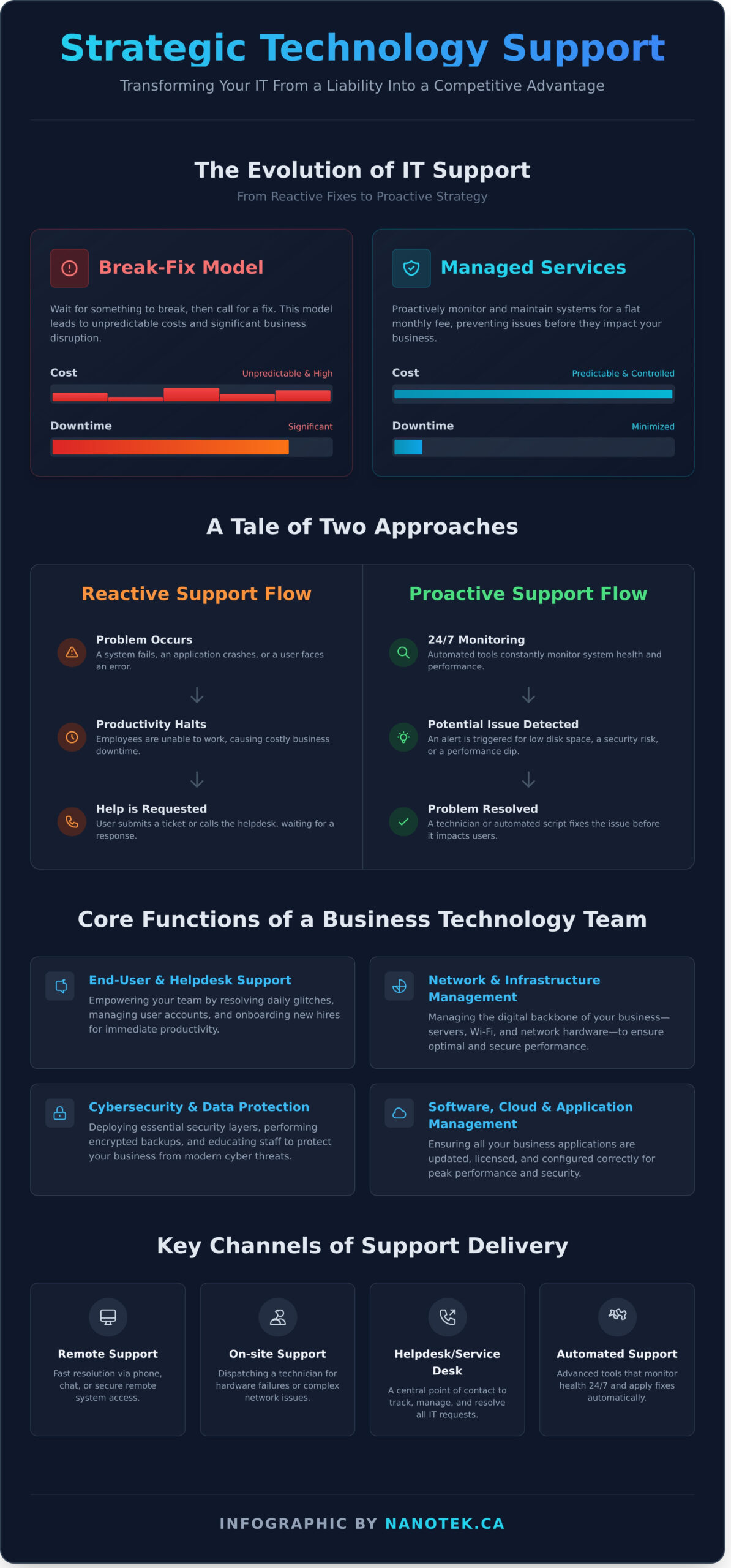
The traditional “break-fix” model was simple: when a device failed, you called a technician and paid for the service. This approach, however, leads to unpredictable costs in Canadian dollars (CAD) and, more importantly, extended downtime while you wait for a resolution. Today, businesses are shifting to a proactive Managed Services model. This subscription-based approach focuses on preventing issues before they occur, transforming IT from a reactive expense into a strategic asset that drives efficiency.
Reactive vs. Proactive Support: Which Does Your Business Need?
A comprehensive support strategy combines two key approaches. Reactive support is the essential helpdesk function that responds to user-submitted issues and tickets. Proactive support, on the other hand, involves continuous system monitoring, security patching, and performance optimization to identify and resolve potential problems before they can impact your operations. A modern business requires a blend of both-proactive measures to maintain stability and a responsive helpdesk to empower employees when they need immediate help.
Key Channels of Technology Support Delivery
Effective support is delivered through multiple channels to ensure swift and appropriate resolution. The goal is to provide the right expertise exactly when and where it’s needed.
- Remote Support: Technicians solve issues efficiently over the phone, via chat, or by securely accessing systems remotely.
- On-site Support: For hardware failures or complex network issues, a technician is dispatched to your physical location.
- Helpdesk/Service Desk: This serves as the central point of contact for all IT requests, ensuring every issue is tracked and managed.
- Automated Support: Advanced software tools monitor system health 24/7, often applying fixes automatically without human intervention.
Core Functions of a Business Technology Support Team
Many business owners think of IT support as the team you call only when a computer breaks. While that’s part of the job, a modern technology support provider delivers a far more comprehensive and proactive service. Their role is to build and maintain a secure, reliable, and efficient technology foundation that prevents problems before they can disrupt your operations. These core functions work in concert to empower your team and protect your business.
End-User and Helpdesk Support
This is the most visible function, focused on empowering your employees to work without interruption. Responsibilities include resolving daily software glitches, managing user accounts and password resets, and fully onboarding new hires with the right equipment and access. For example, when you hire a new team member, we ensure their laptop, email, and software access are ready on day one, allowing them to be productive immediately.
Network and Infrastructure Management
Behind the scenes, your support team manages the digital backbone of your business. This involves ensuring your servers, Wi-Fi, and network hardware are running optimally and securely. We monitor network performance to prevent slowdowns and manage firewalls to block threats. Think of it like this: if your retail store’s network goes down, your ability to process payments stops. We keep it stable and plan for upgrades as your business grows.
Cybersecurity and Data Protection
In today’s threat landscape, protecting your data is non-negotiable. This critical function involves deploying and managing essential security layers, including antivirus, anti-malware, and advanced email filtering. A key part of our managed technology support includes:
- Performing regular, encrypted data backups and testing disaster recovery plans.
- Keeping all systems patched and updated to protect against the latest vulnerabilities.
- Educating your staff on how to identify and avoid phishing, social engineering, and other common cyber threats.
Software, Cloud, and Application Management
Your business runs on software, and managing it efficiently is crucial. This role involves overseeing software licenses for platforms like Microsoft 365 to ensure you are compliant without overpaying. We also provide expert support for cloud services like Microsoft Azure or our own NanoCloud, ensuring your critical business applications are always updated and available. When an issue arises with a third-party vendor, we act as your technical liaison, saving you valuable time and frustration.
The Tangible Business Impact of Professional Tech Support
Viewing IT as a cost centre is a common but outdated perspective. In today’s digital-first economy, professional technology support is a strategic investment that delivers a measurable return. It’s not just about fixing what’s broken; it’s about optimizing operations, mitigating critical risks, and empowering your team to perform at its best. By translating technical services into tangible business outcomes, you can see how expert support directly contributes to your bottom line.
Maximizing Uptime and Employee Productivity
Every minute of IT downtime costs your business money. For a small Canadian business, an hour of system failure can translate to thousands of dollars in lost revenue and wages. Proactive support minimizes these interruptions by monitoring your systems and addressing potential issues before they cause a shutdown. When problems do occur, rapid resolution ensures your employees get back to their core tasks quickly, boosting both productivity and morale by eliminating technological frustration.
Strengthening Your Cybersecurity Posture
The threat of a cyberattack is a significant concern for any business owner. According to the Canadian Internet Registration Authority (CIRA), the cost of a single data breach for a Canadian organization can easily exceed C$100,000-a potentially catastrophic expense. Professional IT support acts as your cybersecurity shield, implementing robust security protocols to protect sensitive client and company data. We help you navigate and maintain compliance with regulations like Canada’s PIPEDA, giving you peace of mind that your digital assets are professionally managed and secure.
Enabling Strategic Growth and Scalability
Exceptional technology support does more than just maintain the status quo; it helps you plan for the future. We act as your strategic partner, providing expert guidance on adopting new technologies that can sharpen your competitive edge and improve efficiency. As your business grows, we ensure your IT infrastructure is ready to scale with you, preventing performance bottlenecks and supporting your expansion seamlessly. Let us handle the technical complexities. Let us build a technology roadmap for your business.
Choosing Your Support Model: In-House vs. Outsourced
Once you recognize the critical need for professional IT management, the next strategic decision is how to structure it. Businesses essentially have two paths for acquiring dedicated technology support: building an internal team or partnering with an external expert. This choice directly impacts your budget, operational efficiency, and ability to scale. Understanding the trade-offs is key to building a resilient technology foundation.
The Pros and Cons of an In-House IT Team
Hiring an in-house IT professional provides an immediate, on-site presence and a deep understanding of your unique company culture and processes. However, this model comes with significant drawbacks. The cost of a single, qualified IT manager in Canada can easily exceed C$100,000 per year including salary, benefits, and training. This single hire creates a knowledge silo and a point of failure; what happens during vacation or sick leave? Furthermore, it’s impossible for one person to be an expert in every critical area, from cybersecurity to cloud infrastructure.
Benefits of Partnering with a Managed Service Provider (MSP)
An MSP, or Managed Service Provider, acts as your complete, outsourced IT department. Instead of the high cost of a single employee, you gain access to an entire team of certified specialists for a predictable, flat monthly fee. This model delivers comprehensive value:
- Cost-Effectiveness: Access a full team of experts for a fraction of the cost of hiring even one senior technician.
- 24/7 Proactive Support: We monitor your systems around the clock to prevent issues before they cause downtime, eliminating coverage gaps.
- Broad Expertise: Leverage specialized knowledge in cybersecurity, cloud computing, data backup, and strategic IT planning without having to hire for each role.
How to Decide Which Model is Right for You
The right choice depends on your specific business needs. Ask yourself these critical questions:
- Budget: Can your business sustain the high, fixed costs of an in-house salary, or does a predictable, scalable operational expense make more sense?
- Growth: Will your technology support scale seamlessly as your company expands, or will you need to undergo a slow and expensive hiring process?
- Security: Do you have the in-house expertise to defend against the sophisticated cyber threats targeting Canadian businesses today?
For most small and medium-sized businesses, the MSP model provides the most strategic value. It delivers enterprise-level expertise and proactive security at a cost-effective price point, empowering you to focus on your core business goals. Let us handle the technology, so you can drive your business forward. To learn more, see how the team at Nanotek can help.
What to Look for in a Technology Support Partner
Choosing the right partner is the most critical step in outsourcing your IT. The right provider becomes a strategic asset, driving efficiency and growth, while the wrong one can lead to costly downtime and frustration. To make an informed decision, you need a clear framework for evaluating potential partners. Let us help you identify the key indicators of a quality technology support provider.
Key Questions to Ask Potential IT Providers
Arm yourself with direct questions that cut through sales pitches and reveal a provider’s true capabilities. A confident and transparent partner will have ready answers for the following:
- What are your average response and resolution times? Look for a provider that distinguishes between acknowledging a ticket (response) and solving the problem (resolution).
- Can you provide references from clients in my industry? A partner with experience in your sector understands your unique compliance, software, and operational needs.
- How do you handle cybersecurity and data backup? Ask about their security stack, disaster recovery protocols, and how they test backups to ensure data integrity.
- What is included in your service plans and what costs extra? Avoid surprise bills. A reputable provider offers clear, all-inclusive pricing that outlines project work, on-site visits, and after-hours support.
Understanding Service Level Agreements (SLAs)
A Service Level Agreement (SLA) is more than a contract; it’s a commitment. This document legally defines the level of service you can expect, including crucial metrics like guaranteed response times for critical issues and system uptime percentages (e.g., 99.9% uptime). Ensure the SLA aligns with your business’s operational hours and tolerance for downtime. Crucially, it should also clarify the penalties or service credits you will receive if the provider fails to meet these obligations, holding them accountable for their promises.
The Advantage of Local Expertise in the GTA
In a dynamic market like the Greater Toronto Area, a local partner offers a distinct advantage. A provider familiar with the local business landscape understands the specific challenges and opportunities you face. When a critical server fails or you need hands-on help, having a team that can provide fast on-site support for businesses in Toronto, Mississauga, and Brampton is invaluable. A local partner is more than a vendor; they are invested in the community and in your success. Nanotek has been supporting GTA businesses since 1998.
Empower Your Business with Strategic Technology Support
In today’s fast-paced digital landscape, technology support is no longer just a reactive fix-it’s a proactive, strategic asset that drives efficiency, enhances security, and fuels growth. As this guide has shown, the difference between thriving and just surviving often comes down to your support infrastructure. Choosing the right model, whether in-house or outsourced, and the right partner is a critical decision that directly impacts your bottom line and competitive edge in the Canadian market.
For businesses in demanding sectors like healthcare, legal, and manufacturing, a proven partner makes all the difference. Nanotek has been driving businesses forward since 1998, delivering expert IT solutions tailored to unique industry needs. Our track record-including over 110,000 resolved support tickets and 650+ completed cloud migrations-is a testament to our commitment. We provide the comprehensive technology support that transforms your IT from a cost centre into a strategic advantage.
Let us take care of your IT, so you can take care of your business. Book a free consultation today and let’s start building a more resilient, efficient, and secure future for your company.
Frequently Asked Questions About Technology Support
What is the difference between IT support and managed services?
Traditional IT support is typically reactive, operating on a “break-fix” model where you call for help when a problem occurs. In contrast, managed services are proactive. A managed service provider (MSP) continuously monitors, maintains, and secures your IT infrastructure to prevent issues before they impact your business. This partnership approach focuses on optimizing your entire technology environment for a predictable monthly fee, rather than billing by the hour for unexpected emergencies.
How much does business technology support typically cost?
In Canada, costs vary based on the service model. Reactive, on-demand support is often billed hourly, ranging from C$125 to C$250+ per hour. Proactive managed services are typically priced per user or per device monthly, often falling between C$75 and C$200 per user. The final cost depends on your company’s size, the complexity of your IT environment, and the specific services included in your plan, such as cybersecurity and cloud management.
Is my business too small for professional technology support?
No business is too small to be impacted by downtime or a security breach. Professional technology support is scalable to fit any size organization, from a single-person startup to a growing enterprise. For small businesses, outsourcing provides access to a full team of experts and advanced security tools at a fraction of the cost of hiring an in-house IT specialist. It’s a strategic investment to protect your operations and enable secure growth.
What are the first steps to getting started with an IT support provider?
The journey begins with an initial consultation to discuss your business goals, pain points, and current technology setup. We then conduct a comprehensive assessment of your IT infrastructure to identify vulnerabilities and opportunities for improvement. Based on these findings, we present a tailored support proposal with clear, transparent pricing. Once approved, we manage a seamless onboarding process to integrate our support systems with your business operations with minimal disruption.
How quickly can I expect a response when I have an IT problem?
Response times are guaranteed in your Service Level Agreement (SLA) and are prioritized by urgency. For critical issues that halt business operations, such as a server failure, you can expect a response within 15-30 minutes. For high-priority but less critical requests, our target is under one hour. Our client portal and dedicated support line ensure your request is acknowledged immediately and that we begin resolving the issue as swiftly as possible.
Do you support industry-specific software, like for healthcare or legal firms?
Yes, we specialize in supporting the unique technology needs of various sectors across Canada. Our team has deep experience with industry-specific applications, including EMR/EHR systems for healthcare, case management software for legal firms, and ERP platforms for manufacturing. We collaborate with your software vendors to manage updates, troubleshoot issues, and ensure your critical applications are secure, compliant with regulations like PIPEDA, and running efficiently.